Sharp Actius PC-GP20 Manuale Utente Pagina 3

  • Scaricare
  • Aggiungi ai miei manuali
  • Stampa
  • Pagina
    / 14
  • Indice
  • SEGNALIBRI
  • Valutato. / 5. Basato su recensioni clienti
Vedere la pagina 2
(303) 464-1919 www.dbmoptics.com
Mode-hop free performance across the band
under nominal conditions. When operating
with the wavelength reference, even if the
laser does mode-hop, the TLS will detect and
correct for this anomaly, which can occur with
any laser under some conditions
Wavelength resolution of 0.08pm
to precisely characterize narrow
band DWDM components
Continuous sweep at 1–1000 nm/second; with a typical sweep of 100
nm/sec, characterization of full C+L band components in less than 1
second. If desired, the laser can be slowed to any speed between
1 and 1000 nm/second.
Output power of +3 to -3 dBm with low noise gives
sufficient power with the CSA or Swept
Spectrometer to characterize even the deepest
components—even with the TLS power
split to several test benches. The High power
version provides +8 dBm
Output power is very stable. When used with the
dBm power reference option, any uncertainty due
to output power variation is eliminated.
The Wavelength Reference Option brings
accuracy to between 1 pm and 5 pm.
Without the Wavelength Reference
Option, accuracy is still 30 pm
in both stepping and continuous sweep
modes.
Easy to use from the front panel,
ethernet or GPIB
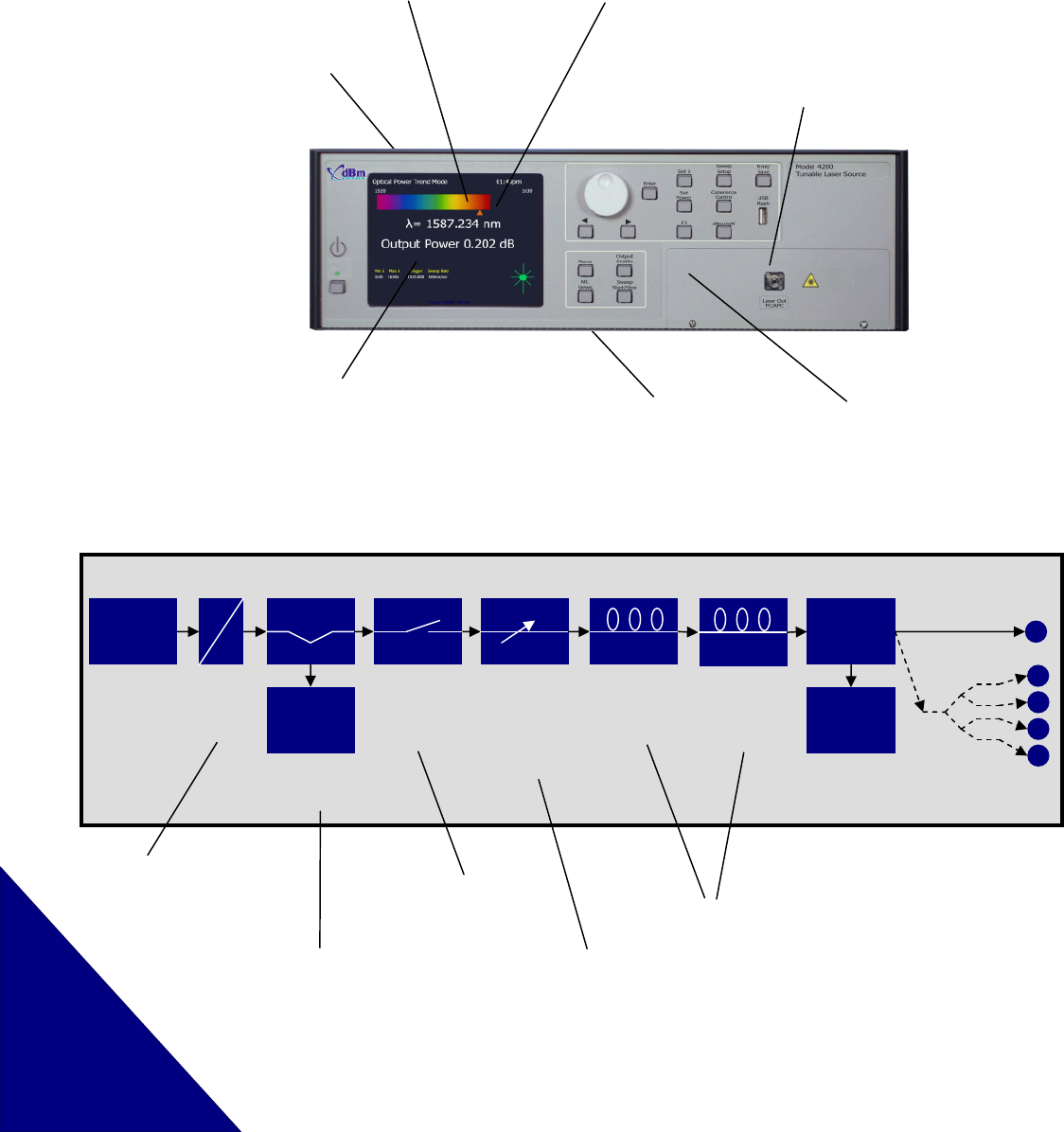
Model 4200 Tunable Laser Source
Overview
TLS
Pol Cntrl
Atten
TLS
Out
4- and 6-state
Polarization
State Controller
(optional)
Pol Srmbl
High-speed
Polarization
Scrambler
(optional)
Shutter
>120 dB
High-speed
Shutter
(optional)
Enhanced
Extinction
Ratio
(optional)
0-40 dB
Attenuator or
Superposition
Precision
Dual Attenuator
(optional)
Splitter
Wave
Ref
2x2
Lo PDSR
Splitter
Pref
Wavelength
Reference
(optional)
Power Monitor
(optional)
Model 4200 Tunable Laser Source
GP-14
Optional Source
Split for multiple
test benches
Built-in shutter
option eliminates
turn-on delay
Attenuator options
allow wide power
variation without
effecting the noise
and SMSR of the
TLS
Built-in polarization
scrambling,
sweeping, or
orthogonal state
generation
Eliminate the
effect of
polarization state
wobble and
increase PER
150nm+ tuning range
Vedere la pagina 2
1 2 3 4 5 6 7 8 ... 13 14

Commenti su questo manuale

Nessun commento